Responding to Natural Capital and Biodiversity
Initial Disclosure Based on TNFD
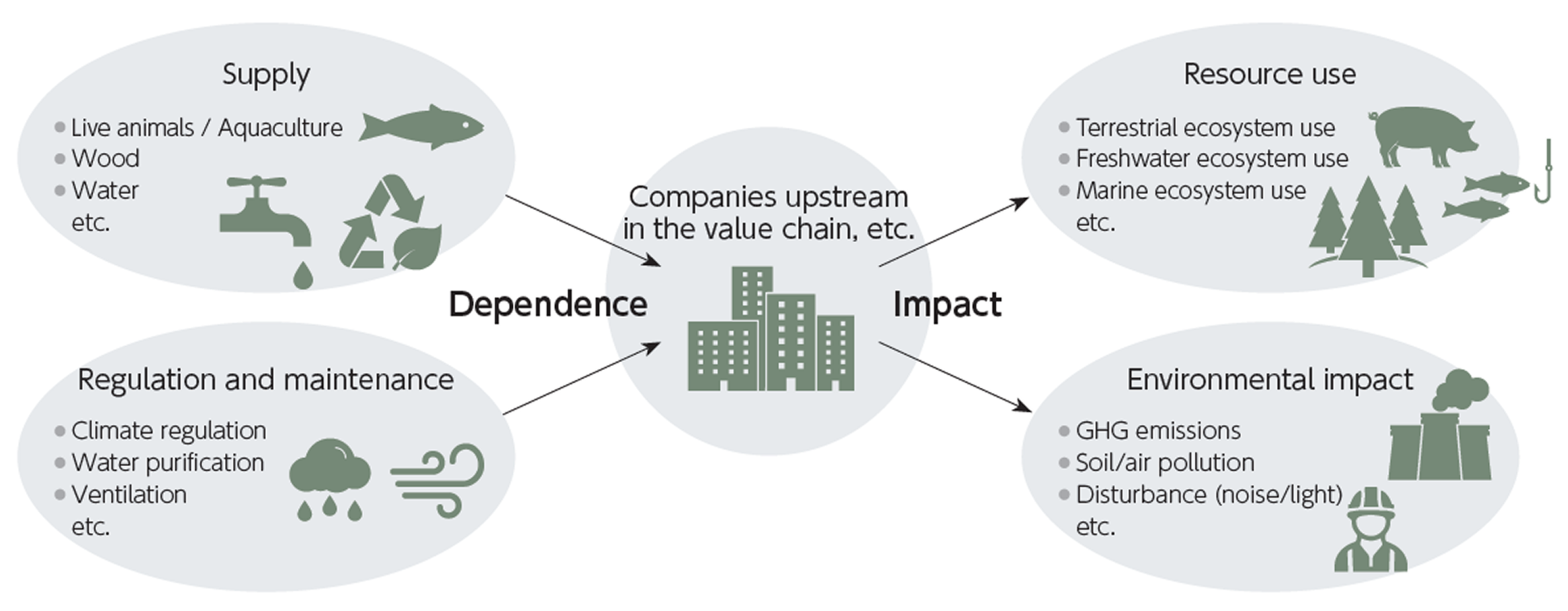
Our group understands that in conducting our business activities, we both benefit from and influence natural capital. As stated in our Environmental Policy and Sustainability Basic Policy, we recognize that consideration for the natural environment, including the effective use of resources and the reduction of environmental impact, is an indispensable element for achieving sustainable development.
Against this backdrop, in July 2025, our company endorsed the TNFD's information disclosure recommendations and registered as a TNFD Adopter.
Going forward, we will actively pursue analysis and information disclosure based on the recommendations of the Natural Capital Development Framework (TNFD) to understand our dependence on and impact of natural capital in our business activities.
Implementation of Analysis Based on TNFD
Introducing the LEAP approach
Our company interacts with a diverse range of ecosystem services in the course of our business activities, including raw material procurement, processing and manufacturing, transportation, and sales. In order to build a sustainable symbiotic relationship with nature, we determined that it is necessary to understand the extent of our connection to nature, our dependence on it, and our impact on it, as well as to consider the risks and opportunities. Therefore, using the framework of the TNFD Final Recommendations (v1.0) as a reference, we undertook the scoping phase (red box area), which is the entry point of the LEAP approach, and analyzed the sectors in our company that are highly dependent on and highly impacted by natural capital.

Analysis tools and analysis targets
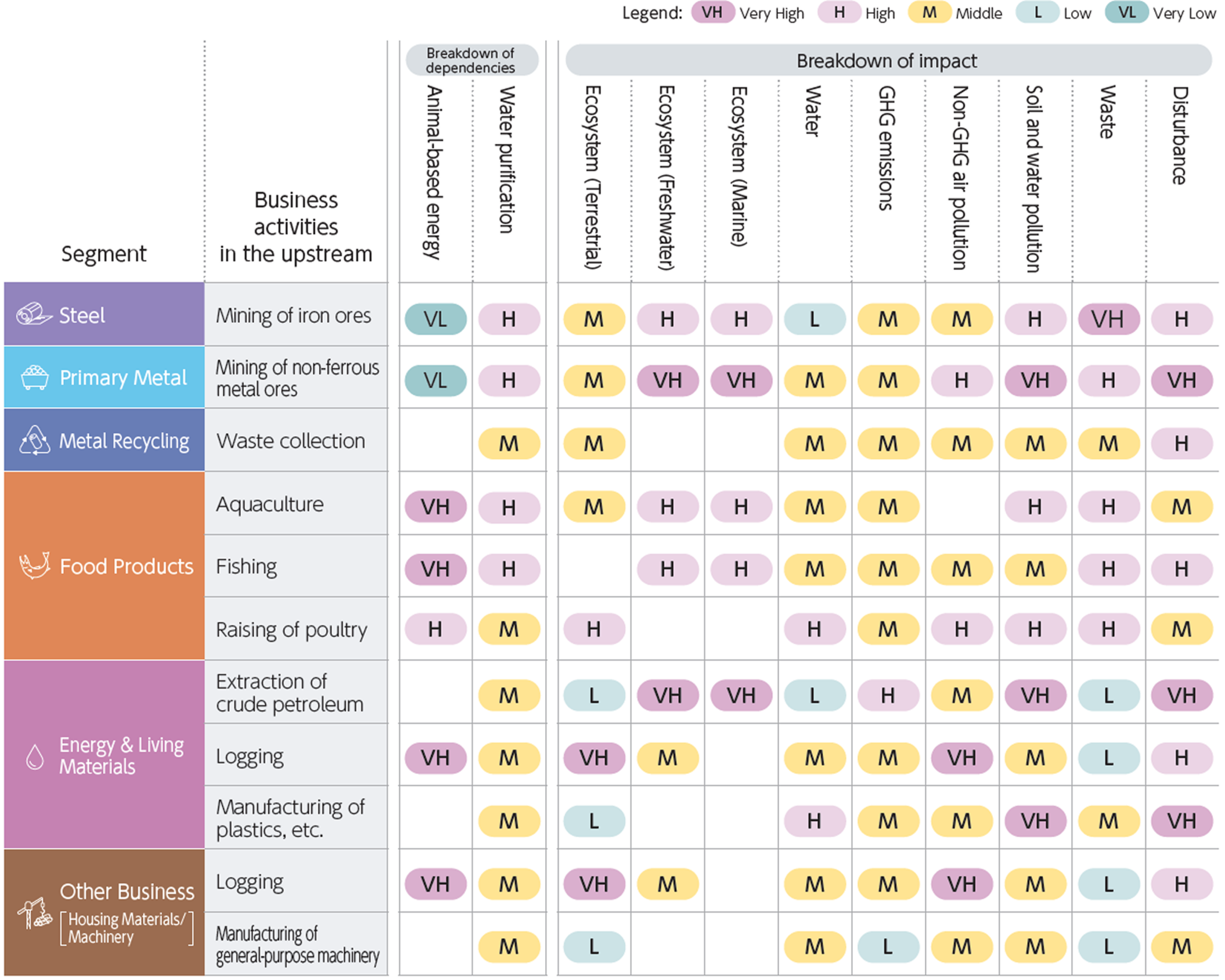
As an analytical tool, we utilized ENCORE, recommended by TNFD. ENCORE is a suitable tool for visualizing the potential dependence on and impact of corporate activities on nature. For this analysis, we set the scope to our "upstream value chain." We applied the most relevant industry classification to each of our business segments and evaluated the magnitude of the dependence and impact. The evaluation was conducted on a five-point scale: "Very High," "High," "Middle," "Low," and "Very Low."
Analysis Results in Each Project
An analysis of the upstream value chain of our business revealed that the businesses that rely heavily on natural capital are the "Food Division," "Energy and Life Living Materials Division," and "Other Businesses (housing materials Business)." Furthermore, the businesses that have a significant impact on nature are the "Steel Division," "Primary Metal Division," "Energy and Life Living Materials Division," and "Other Businesses (housing materials Business)." This report includes only items that qualify as "VH (Very High)" and those highly relevant to our business.
The consequences of our dependence on and impact on nature in the upstream of our value chain
Future Initiatives
Moving forward, based on the results of this analysis, we will implement the "LEAP approach," which takes into account our actual geographical location, the characteristics of our business activities, and the scale of our capital. Through this approach, we will strive to more accurately grasp the actual risks and opportunities related to our natural capital, and to build an appropriate management system and disclose information accordingly. Ultimately, we aim to disclose information in accordance with the TNFD framework (v1.0).