
Corporate Governance
Corporate Governance Policy
To fulfill our social responsibility as a good corporate citizen and to earn the recognition and support of our stakeholders as a "valuable company," we aim to establish a highly transparent management system that complies with laws and social norms.
Furthermore, with the aim of coexisting with the Earth and society and achieving sustainable development, we have established a "Sustainability Promotion Committee" and are promoting sustainability management.
Our policy regarding compliance with the Corporate Governance Code
Corporate Governance System
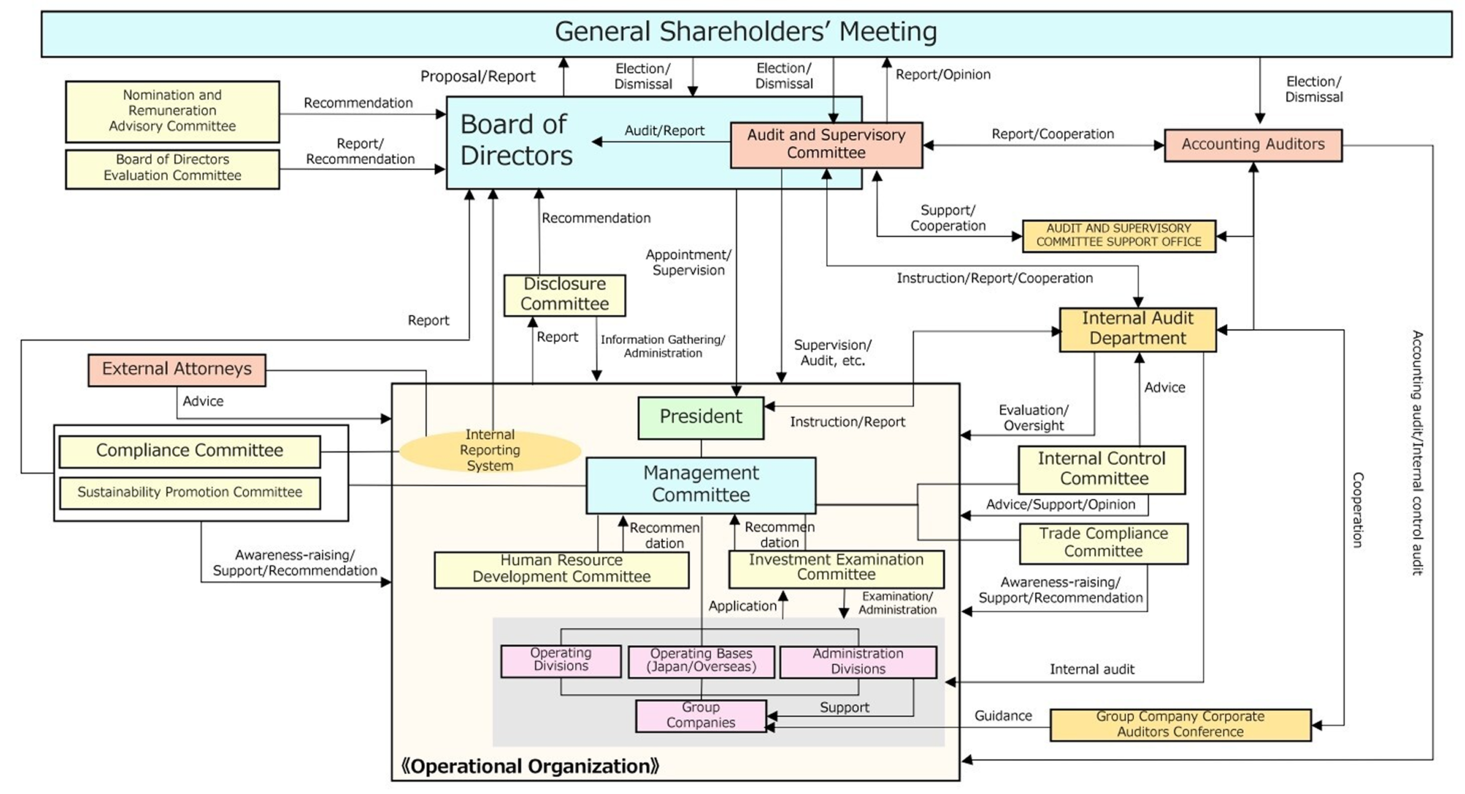
Our company adopts the form of a company established with Audit and Supervisory Committee. The Audit and Supervisory Committee consists of four directors who are Audit and Supervisory Committee members appointed by the General Shareholders' Meeting (including three outside directors). Through hearings of opinions from executive directors and attendance at Management Committee by full-time audit and supervisory committee members, audits are conducted from the perspective of legality and appropriateness in the execution of duties. The results are approved by the Audit and Supervisory Committee and reported to the General Shareholders' Meeting.
Since April 2012, our company has established a more detailed business execution system and introduced an executive officer system to accelerate and streamline decision-making.
Board of Directors consists of 13 directors appointed by the General Shareholders' Meeting (including 6 outside directors), and is held monthly in principle to decide matters stipulated by laws and the Articles of Incorporation, plan important management matters for our Group, and supervise business execution.
Management Committee is mainly composed of executives at the executive director level and above, as well as full-time audit and supervisory committee members. Important matters related to the management decisions of our group are submitted to the Board of Directors, and as the highest business execution body, we hold meetings twice a month in principle to promptly promote business execution in line with the management policies decided by the Board of Directors.
Regarding personnel and treatment of officers, we have established an Executive Nomination and Remuneration Committee, chaired by an outside director and composed of a majority of the members, and have adopted the following procedures.
Regarding executive personnel matters, the Executive Nomination and Remuneration Committee will review the composition of officers for the following year based on the results of executive evaluations and employee personnel evaluations, prepare a draft, submit recommendations to Board of Directors, and Board of Directors will be regularly General Shareholders' Meeting as executive candidates.
Regarding executive compensation (excluding those for directors who are Audit and Supervisory Committee members), the Executive Nomination and Compensation Committee reviews based on the results of the executive evaluation, then prepares a fixed monthly salary plan for the following year, and makes decisions at Board of Directors. Regarding executive bonuses, we adopt a performance-linked salary system for executive directors to more clearly reflect their responsibility for results. The proposed rules for calculating performance-linked salaries each year are reviewed by the Executive Nomination and Compensation Committee and decided by Board of Directors. Furthermore, restricted stock compensation targets executive directors and is positioned as compensation for the responsibility of each management team to enhance corporate value to shareholders according to their position. The Executive Nomination and Remuneration Committee reviews the appropriate level for each position, and determines the specific number of shares to be paid (the amount of monetary compensation claims applied to payment for the acquisition price) by Board of Directors.
Regarding the effectiveness evaluation of Board of Directors, we have introduced a system where the Board of Directors Evaluation Committee, composed of all outside directors and chaired by one of the outside directors, reports the evaluation results and proposes improvements to the Board of Directors.
Evaluation of the Effectiveness of Board of Directors
Since fiscal year 2019, our company has been analyzing and evaluating the effectiveness of Board of Directors Board of Directors and working to further improve its functions. We have now conducted an effectiveness evaluation of Board of Directors for fiscal year 2025, and we disclose the outline and results below.
-
Evaluation method
For the effectiveness evaluation of Board of Directors evaluation in fiscal year 2025, the evaluation was conducted with the support of a third-party organization.
- An anonymous questionnaire survey was conducted among all directors (14 directors were surveyed).
- Discussion at Board of Directors Evaluation Committee (8 members present)
- Discussion at Board of Directors (14 directors in attendance)
- Survey content
- The structure, composition, and operation of Board of Directors
- Effectiveness of discussions and oversight/monitoring functions within Board of Directors
- The composition, roles, and operational status of each committee (evaluation, nomination, compensation) and Audit and Supervisory Committee
- Performance and training of internal and external directors
- Dialogue with shareholders (investors)
- Summary of evaluation results
-
Summary
Based on this evaluation, we have concluded that our Board of Directors is fundamentally operating appropriately and that Board of Directors effectiveness is ensured. Furthermore, we have confirmed that frank and constructive discussions are taking place among internal and external directors under the leadership of the Chairman.
-
Improvements based on the results of the previous effectiveness evaluation
In response to the issue identified in the previous effectiveness assessment, "strengthening the supervisory function of Board of Directors, including the delegation of authority to Management Committee and the design of the organizational structure," progress has been made in addressing the transition to a company with Audit and Supervisory Committee committee, as well as in discussions regarding the delegation of authority to the executive side, including the management Management Committee, that accompanies the transition. In addition, regular reporting on risk assets and the effective exercise of monitoring functions centered on the audit and supervisory Audit and Supervisory Committee have been confirmed.
- Issues that remain recognized
- Further enrichment of discussions regarding medium- to long-term management strategies, business portfolios, and human resource strategies.
- Clarification of discussions and processes regarding succession planning, including President.
- Further improvement in the quality and organization of information provided by the executive team to Board of Directors
- Strengthening our investor relations (IR) system to ensure that our medium- to long-term growth strategy is adequately communicated to the capital markets.
-
Based on the results of this evaluation and the issues identified through previous effectiveness assessments, our Board of Directors will work to enhance the effectiveness of Board of Directors and improve our governance system in order to sustainably improve corporate value.
[Corporate Governance Overview Diagram]
Internal Control Policy
Our company has established a basic policy regarding the establishment of a system to ensure that the execution of duties by directors complies with laws and regulations and the articles of incorporation, as well as other systems to ensure the proper conduct of business (hereinafter referred to as the "internal control system"), in order to ensure that corporate governance functions effectively, reduce risks related to achieving business objectives, and achieve sustainable growth and development.
Basic policy on the establishment and operation of internal control systems
- System to ensure that the performance of duties by directors, executive officers, and employees of the HANWA Group, which consists of our company and its subsidiaries, complies with laws and regulations and the articles of incorporation.
- Based on our corporate philosophy, including our company motto and principles, we have established the HANWA Group's corporate ethics code and corporate ethical conduct standards.
- Our company has established a Compliance Committee, and this committee will ensure that the contents of the Compliance Manual are thoroughly disseminated to all officers and employees of the HANWA Group, making it available for viewing at any time, in order to ensure its effectiveness.
- HANWA Group will establish internal and external reporting channels for compliance-related issues for all officers and employees, ensuring a system for reporting problems when they occur. Furthermore, it will guarantee that informants will not suffer any adverse treatment for making a report. In addition, in the event of an inappropriate situation, the company will fulfill its obligation to promptly and accurately disclose information and provide explanations to the public, while also striving for thorough investigation of the cause and prevention of recurrence.
- We will take a firm stance against antisocial forces that threaten the order and safety of civil society, in cooperation with the police and other relevant authorities, and resolutely sever all ties with them.
- System for the preservation and management of information related to the execution of duties by our directors
- Our company will properly record information related to the execution of duties by our directors in written or electronic documents (hereinafter referred to as "documents"), and will store and manage them in accordance with laws and regulations and our company's document management rules.
- The person in charge of document management shall take care to prevent the loss or damage of stored documents, and shall manage them properly by taking measures such as locking (including access restrictions using passwords, etc.) when necessary.
- Regulations and other systems concerning the management of the risk of loss within HANWA Group
- Our company has established a basic risk management policy to ensure that we understand all risks within the HANWA Group and take appropriate countermeasures to control those risks. Risk Management Dept. will work in cooperation with relevant departments to manage individual risks, monitor countermeasures, and periodically assess the overall risk level for the group as a whole, reporting to Management Committee and Board of Directors as appropriate.
- Our directors, executive officers, board members, department heads, and subsidiary President will work in cooperation with Credit Dept. to ensure that each department and subsidiary is fully aware of and adheres to the proper implementation of credit management regulations and sales department operational regulations, thereby managing and mitigating business risks. Furthermore, we have established an Investment Review Committee as a review body for new businesses, investment and financing projects, and transactions where special risks are a concern. This committee will review investment risks within HANWA Group and report the review results to the respective decision-makers.
- Our company's departments, including General Affairs Dept., Information System Dept., Quality Safety and Environment Control Dept., Risk Management Dept., Legal Dept., Credit Dept., and Sustainability Promotion Office, collaborate to manage risks related to compliance, the environment, disasters, information security, and trade management, based on internal regulations and manuals. Furthermore, various committees, such as the Compliance Committee, serve as advisory bodies, providing guidance and education to each department, and seeking advice from external lawyers as needed.
- Our company will conduct necessary education and awareness campaigns to ensure that relevant departments within HANWA Group are thoroughly informed about risk management practices, through collaboration among them.
- To verify the effectiveness of HANWA Group's risk management, Internal Audit Dept. will monitor the company's domestic and international locations and group companies based on a predetermined audit plan determined by Internal Audit Dept. 's risk assessment, and will provide internal audit reports to Management Committee, President, and Board of Directors as appropriate.
- Our company has established disclosure regulations regarding the disclosure of company information, and a Disclosure Committee makes judgments about the importance and appropriateness of the information to be disclosed, thereby promoting fair, timely, and appropriate information disclosure.
- Based on our Group Company Management Regulations and Group Company Financial Management Regulations, we will properly manage the risks associated with our group companies by establishing appropriate authority management and reporting systems for each of them.
- A system to ensure that the directors of HANWA Group perform their duties efficiently.
- Our company holds Board of Directors meeting at least once a month to formulate important management plans and supervise the execution of business operations for HANWA Group. We also hold Management Committee at least twice a month to discuss and decide on important management matters. Furthermore, directors submit important matters related to the management decisions of HANWA Group to Board of Directors Board of Directors agenda items, in accordance with the criteria for proposals to the Board.
- Our company requires its subsidiaries to report on the status of their business operations monthly, and also receives reports from all sales departments, including some domestic subsidiaries, at monthly reporting meetings held in principle once a month. This allows us to verify the direction, efficiency, and presence of inherent risks of HANWA Group's operations.
- In order to realize our medium- to long-term management strategy, we formulate medium-term and annual management plans, and promote the execution of duties by conducting regular goal meetings for each business division and subsidiary, etc., to evaluate operations and check the status of operations (including revising plans and changing methods for achieving plans).
- Our company holds an Executive Evaluation Committee at least twice a year, chaired by the President and comprised of members including outside directors acting as advisors. The committee conducts a comprehensive evaluation based on an assessment of commitments from executive directors and executive officers (excluding President and outside directors) and peer evaluations among the officers. Based on the results, the Executive Compensation Committee, whose majority of members are outside directors, decides on a proposal for executive compensation, including director compensation, and the Executive Nomination Committee decides on a proposal for executive personnel, including the appointment of directors, and submits these recommendations to Board of Directors.
- System for ensuring the proper conduct of business within HANWA Group
- Based on our group company management regulations, we aim to achieve overall business development by ensuring smooth operations through mutual cooperation between our company and our subsidiaries.
- The department or officer in charge at our company will be responsible for understanding the operational status of our domestic and overseas subsidiaries, and the relevant departments will support their proper execution and provide comprehensive management of those operations.
- Our company holds a liaison meeting of auditors from group companies, comprised of members of the Audit and Supervisory Committee, subsidiary auditors, Internal Audit Dept., and the Group Support Section, as needed, to exchange and share information regarding audits and related matters of our company and its subsidiaries.
- Matters concerning the employee when our Audit and Supervisory Committee requests to appoint an employee to assist with their duties, matters concerning the employee's independence, and ensuring the effectiveness of instructions to the employee Our company establishes a Audit and Supervisory Committee Support Office composed of dedicated employees who have secured independence to assist Audit and Supervisory Committee duties. Employees belonging to the Support Office conduct investigations and reports under the direction and orders of the Audit and Supervisory Committee, and always coordinate with the Audit and Supervisory Committee. Furthermore, these employees do not receive orders from directors other than the Audit and Supervisory Committee members, ensuring their independence. Furthermore, personnel evaluations and transfers of such employees require the consent of Audit and Supervisory Committee.
- Our directors (excluding directors who are Audit and Supervisory Committee members). ), Executive officers, employees, and directors, auditors, executive officers, and employees of subsidiaries report to our Audit and Supervisory Committee and other systems related to reporting to our Audit and Supervisory Committee
- Our directors (excluding directors who are audit and supervisory committee members), executive officers, employees, and directors, auditors, executive officers, and employees of our subsidiaries shall report to our Audit and Supervisory Committee on matters related to significant risks and violations of laws and regulations or the articles of incorporation, in addition to matters required by law. Furthermore, full-time audit and supervisory committee members shall constitute the Compliance Committee as observers, establishing a system to grasp important compliance matters, such as summaries of reports to the compliance reporting hotline. In addition, our directors (excluding directors who are audit and supervisory committee members) and executive officers shall report to Audit and Supervisory Committee on the status of business execution and important decisions at Board of Directors meetings, Management Committee, and other important meetings.
- For matters requested by our Audit and Supervisory Committee to report, our directors (excluding directors who are Audit and Supervisory Committee members) ), executive officers, employees, and directors, auditors, executive officers, employees, etc. of subsidiaries shall respond promptly and accurately.
- Internal Audit Dept. shall, in accordance with the predetermined audit plan, report the status of internal audits to Audit and Supervisory Committee as appropriate, and shall conduct additional investigations and reports as necessary, at the request of Audit and Supervisory Committee.
- Our company prohibits any adverse treatment of the reporter or responder for having made the reports and taken the actions described in the preceding three paragraphs.
- System to ensure that audits by our Audit and Supervisory Committee are conducted effectively.
- Our Audit and Supervisory Committee members will exchange opinions with directors (excluding directors who are Audit and Supervisory Committee members) as appropriate, executive officers, and employees, and will express their opinions to Board of Directors as necessary. They will also cooperate with the accounting auditors by receiving explanations regarding the accounting audit and exchanging opinions with them.
- Our company will establish a system that allows Audit and Supervisory Committee to attend Management Committee and other important meetings, review important documents, and conduct investigations of each business department and our subsidiaries.
- Our company will promptly process the advance payment or reimbursement of expenses incurred in connection with the performance of duties by audit and supervisory committee members (limited to those related to the performance of duties of Audit and Supervisory Committee), as well as any other expenses or liabilities arising in connection with the performance of such duties.
- Systems for ensuring the reliability of financial reporting (regarding the internal control system for financial reporting)
- Based on the Basic Policy on Internal Controls over Financial Reporting, the HANWA Group will appropriately evaluate and report on internal controls over financial reporting, and will strive for the efficient and effective operation of the internal control reporting system.
- The establishment and operation of internal controls over financial reporting within HANWA Group are overseen by Management Committee. Internal Audit Dept. verifies and evaluates the status of the establishment and operation of internal controls over financial reporting and reports the results to Management Committee. Based on this, Management Committee takes corrective actions as necessary.
- The Internal Control Committee, commissioned by Management Committee, examines internal control issues within HANWA Group and reports its findings to Management Committee. It also provides advice and support to Internal Audit Dept. regarding the verification and evaluation of HANWA Group's internal control systems related to financial reporting, and offers opinions to Management Committee on the internal control report.
Corporate Ethics Code and Corporate Ethical Conduct Standards
HANWA Group Corporate Ethics Code
HANWA and its subsidiaries (hereinafter referred to as HANWA Group) are always aware of the social roles and responsibilities they must fulfill under their corporate philosophy, and have established the following ethical code as a fundamental principle for establishing a high level of corporate ethics. All officers and employees will abide by and practice this code in their daily business activities.
-
Compliance with laws and social norms
HANWA Group will comply with laws, international rules, and other social norms, and will promote corporate activities in accordance with the spirit of compliance.
-
Fair business practices
HANWA Group recognizes that fair and free competition is a fundamental rule of the market economy and conducts its business activities accordingly, while maintaining a sound and transparent relationship with the government and administrative bodies.
-
Contribution to industrial society
HANWA Group conducts its business activities with a long-term perspective, not just a short-term one, while balancing social, economic, and environmental aspects, and strives to realize a sustainable society through these activities.
-
Proactive Information Disclosure
HANWA Group fully recognizes the high level of public interest in its corporate activities and strives to ensure corporate transparency by communicating broadly with society and disclosing information fairly and proactively.
-
Environmental considerations
HANWA Group always recognizes that environmental considerations are part of its social responsibility, and will proactively and voluntarily address environmental issues from a global perspective.
-
Harmony with the international community
As a global company, HANWA Group respects the cultures and customs of each region and promotes management that contributes to the development of each region.
-
Establishing a free and open work environment
HANWA Group respects the individuality and personality of its employees, actively supports their career development and skill development, and ensures a rich work environment. Furthermore, recognizing teamwork as the primary focus of its business activities, it aims to create a free, open, and creative corporate culture.
-
Promoting proactive social contribution activities as a "good corporate citizen"
HANWA Group harmonizes corporate profits with the interests of society, broadly returns the results of its business activities to society, and proactively engages in social contribution activities from all perspectives.
-
Thorough dissemination of ethical guidelines
HANWA Group aims to ensure the organic implementation of these standards by having its representatives take the lead in thoroughly disseminating these standards to all relevant parties and by establishing a system for more efficient and effective implementation.
-
Proper business management
HANWA Group will promote proper corporate management in accordance with these standards, and in the event of any inappropriate situation, will fulfill its obligation to promptly and accurately disclose information and provide explanations to society, as well as thoroughly investigate the cause and take measures to prevent recurrence.
HANWA Group Corporate Ethics Code of Conduct
In accordance with the spirit of its corporate ethics code, HANWA Group has established the following Corporate Ethics Code of Conduct as concrete guidelines for ensuring high ethical standards in its daily operations, and each officer and employee will abide by these standards in their own conduct.
- We will comply with the Antimonopoly Act and other relevant laws and regulations, and conduct fair and proper business transactions.
- We will comply with the Unfair Competition Prevention Act and other relevant laws, and strive to maintain a fair and free market environment.
- If qualifications or licenses are required to perform the duties, one must fully understand their requirements and respond appropriately.
- We will comply with various import and export treaties and national laws and regulations, and conduct fair trade transactions.
- We will deal resolutely with antisocial forces and will not provide them with any benefits or other such support.
- We respect intellectual property rights, strictly manage the intellectual property held by the company, and do not infringe on the intellectual property rights of third parties.
- We will comply with environmental laws and regulations and conduct business activities with consideration for the global environment.
- We will not engage in unfair trading practices (insider trading) of stocks and other securities.
- We will comply with the Political Funds Control Act and other relevant laws, and will not engage in illegal political donations.
- We will pay close attention to information management and strive to maintain a healthy information network.
- We will respect human rights and eliminate unfair discrimination, harassment, and other forms of abuse.
- We will abide by laws and regulations that we, as members of society, should follow, such as traffic laws and generally accepted social rules.
- In accordance with our management philosophy, we will comply with laws, international rules, social customs, and internal regulations, and maintain high ethical standards.
- We will cooperate in the development of the local community and actively promote social contribution activities.
- We strive to ensure corporate transparency through proactive information disclosure.
- We will enhance our in-house training programs and strive to develop the expertise and creativity of our officers and employees.
- We maintain a vibrant work environment through fair performance evaluations.
- We will promote active communication and highly transparent sales activities.
- We will avoid conflicts of interest and maintain healthy relationships with our business partners. Furthermore, we will maintain a clear distinction between our personal and professional lives.
- Entertainment and gifts will be conducted in compliance with laws and regulations and within socially acceptable limits.
- We will comply with accounting regulations and other relevant rules, and prepare accounting books and records fairly and appropriately.
- We will comply with credit management regulations and other relevant rules and conduct proper debt management.
- We constantly check the details of contracts with our business partners and the actual state of our business transactions.
- Contracts and other external documents, as well as internal documents, will be prepared appropriately and managed in accordance with company regulations.
- We will give full consideration to safety and hygiene in our business activities and labor management.