
Risk Management
Basic Policy and Concept
Due to the broad nature of its business, the HANWA Group is exposed to various risks, including credit risk, business investment risk, and other related risks. Therefore, the group recognizes risk management as a critical management issue. Having established a basic risk management policy, the "risk" that we define is "uncertainty that affects the achievement of business strategies and business objectives." Rather than viewing risk simply as something to be avoided, we position it as a foundation for achieving dramatic business growth through proactive investment and financing and business expansion by appropriately controlling it.
The following five items are listed as the objectives of risk management:
- Ensuring sound management and maintaining/enhancing corporate value
- Conservation and effective use of management resources
- Continuous and stable business continuity and dramatic business growth
- Maintaining and improving stakeholder trust, and ensuring profits.
- Ensuring the safety and health of executives, employees, and their associates.
Furthermore, we have established a code of conduct that ensures all employees continuously engage in risk management activities, such as recognizing, evaluating, and mitigating risks, in their daily work, and act in a manner that does not harm the interests of stakeholders.
Promotion System and Governance
Our group's risk management is driven by the executive officer in charge of Administrative Division. Important matters, including revisions to the basic risk management policy, are submitted to Board of Directors for deliberation and decision-making. Board of Directors determines and approves response policies and measures, and continuously monitors their implementation.
Our company has established a promotion system based on the 3-line model concept recommended by the COSO-ERM framework.
[Risk Management System]
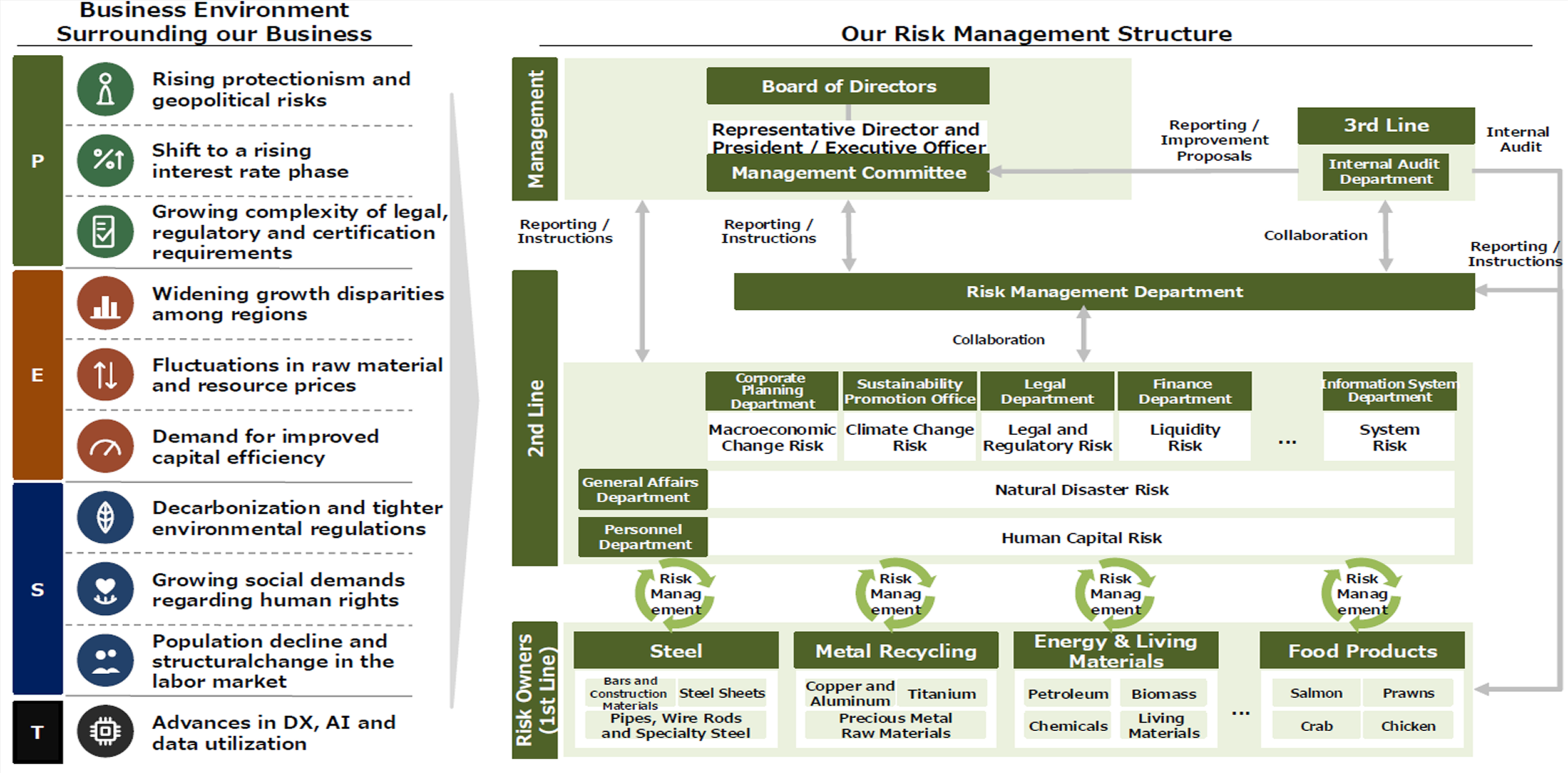
Frontline (Sales Department/Subsidiary)
As a risk owner, I am responsible for identifying and assessing risks in my area of responsibility, implementing measures to mitigate and manage them, and monitoring and reporting on the situation.
Second line of defense (Risk Management Dept. /Risk Management Division)
Independent of the sales department, this role involves formulating fundamental principles and frameworks for risk management, as well as monitoring, checking, and training frontline staff.
Third line of defense (Internal Audit Dept.)
From a position independent of Lines 1 and 2, we verify and evaluate the appropriateness and effectiveness of the risk management framework, report our findings to Audit and Supervisory Committee, the Representative Director President, and Management Committee, among others, and make recommendations for improvement.
The mission of Risk Management Dept. is to formulate and promote company-wide risk management initiatives necessary to take appropriate measures and control various risks that may arise from the business operations of our group.
Please refer to the Securities Report for details.
Evaluation Process
As a fundamental principle of risk management, we promote management based on quantification. We identify the scope of quantification for the risks to be managed and then implement quantitative management according to the characteristics of each risk. Furthermore, we manage the profitability related to the quantified amount of risk and aim to secure appropriate returns commensurate with the risk.
Furthermore, we are working on the following initiatives to enhance our risk management:
- Operations related to top risks (risks that have a significant impact on business operations)
- Management of risk capital (managing the amount of capital required to cover the maximum potential loss that may occur in the future due to risks in business operations)
- Utilizing a risk appetite framework
Furthermore, in order to examine the impact of changes in the macroeconomic environment on our management and operations, we measure the degree of impact on our group under multiple stress scenarios and report this to Board of Directors.
Identification of Major Risks
Our group has designated risks that require particularly focused management as "important risks," and we have clearly defined the types and definitions of these risks.
[List of Important Risks]
| Risk items | definition |
|---|---|
| Credit risk | The risk of incurring losses due to a decrease or loss in the value of assets caused by a deterioration in the financial condition of borrowers in debt, loans, and investments. |
| Country risk | Regarding overseas credit provision, there is a risk of incurring losses due to the foreign exchange situation, political and economic conditions, etc., of the country to which the credit recipient belongs. |
| Business investment risks | Risk of incurring losses due to insufficient effectiveness in decision-making regarding new investments, monitoring existing businesses, and decision-making regarding divestitures. |
| Inventory risk (Risk of fluctuations in commodity value) |
The risk of incurring losses due to a decrease in inventory value as market prices fluctuate due to factors such as decreased demand or oversupply of goods. |
| Compliance risks (Security trade control, etc.) |
Risk of incurring losses due to insufficient compliance with laws and regulations regarding trade-related operations. |
| Market risk (exchange rate risk) | The risk of cash flow being affected by exchange rate fluctuations. |
For details, please refer to the "Business Risks" section of the Securities Report.
Crisis Management and BCP
In the event of an emergency or disaster, our group will prioritize the respect for human life and ensure safety, based on the action guidelines of our basic risk management policy, while striving to take appropriate and prompt action in cooperation with relevant organizations and local communities.
As a basic policy for crisis management, we have established the following three principles:
- Prioritizing the protection of human life.
- To protect assets and ensure a swift recovery of operations.
- If resources are available, we will provide relief and support to neighboring areas.
Establishment of a Crisis Management Headquarters
In the event of a disaster that causes significant disruption to business operations or an incident that threatens the safety of executives or employees, a Crisis Management Headquarters will be established immediately.The Head of the Headquarters will be the Representative Director President, and the Deputy Head will be Administrative Division, an Executive Officer. The Headquarters will consist of Secretarial Office, the Corporate Planning Office General Affairs Dept., Human Resources Dept., and Information System Dept.. In the event that the Head of the Headquarters is unable to assume command, a system is in place for successive succession in accordance with the standards for acting in the absence of the Head.
Emergency contact system and safety confirmation
We create, review, and update emergency contact networks for each department at our head office's domestic business locations, Overseas Offices offices, and domestic group companies.
Furthermore, we have implemented an emergency safety confirmation system, which automatically sends out safety confirmation emails if an earthquake of magnitude 5 or higher occurs at our head office or business location.
Disaster prevention drill
To raise disaster preparedness awareness among executives and employees and improve their ability to respond to disaster emergencies, we conduct regular disaster preparedness drills at least once a year. These drills include training in sending and receiving safety confirmation messages, as well as comprehensive disaster preparedness drills simulating fire and earthquake scenarios.
BCP (Business Continuity Plan)
Regarding BCP (Business Continuity Planning) in the event of a large-scale disaster, we have separately developed a "BCP (Business Continuity Planning) Manual."
Overseas crisis management system
Overseas, we have established an Overseas Crisis Response Headquarters and are taking all possible measures to ensure the safety of our officers, employees, and their families at our Overseas Offices Affairs' overseas travel advisories.
Information Security
Basic Information Security Policy
Our group recognizes that proper management of information assets is essential in a society where information security is increasingly important, and has established an "Information Security Basic Policy." This policy will be reviewed as needed in light of changes in the social environment and technological trends, and we will strive for continuous improvement. In addition, we have formulated guidelines for the use of generated AI and are working to ensure its safe use.
The positioning of business strategy and information risk management
HANWA positions its human resources as the source of value creation and is committed to fostering a corporate culture where every employee can thrive, while also promoting the creation of diverse human resources and organizations that support its business strategy. Furthermore, it is striving to improve productivity and operational efficiency through its IT/DX strategy, which promotes "business model transformation," "strengthening of system infrastructure," and "IT/DX human resource development" in a three-pronged approach. In these business activities centered on human resources, organizations, and IT/DX, information handled across operations and organizations is positioned as a crucial asset that supports management. We recognize that appropriately managing the risks related to these information assets is essential for sustainable growth, and we position information risk management as one of our important management issues.
Promotion system
Regarding our information security system, under the overall management officer (Executive Officer in Charge Information System Dept.), each department head and President of each group company is responsible for information management within their respective organizations. Matters related to information security are reported to Management Committee and senior management as appropriate. The information security basic policy, information management regulations, and information security code of conduct are applied to group companies both domestically and internationally, and efforts are made to ensure that the rules are understood, while monitoring the situation and providing support as needed. The information management regulations and information security code of conduct were formulated with reference to the management items of the international standard ISO 27001.
Monitoring and Incident Response
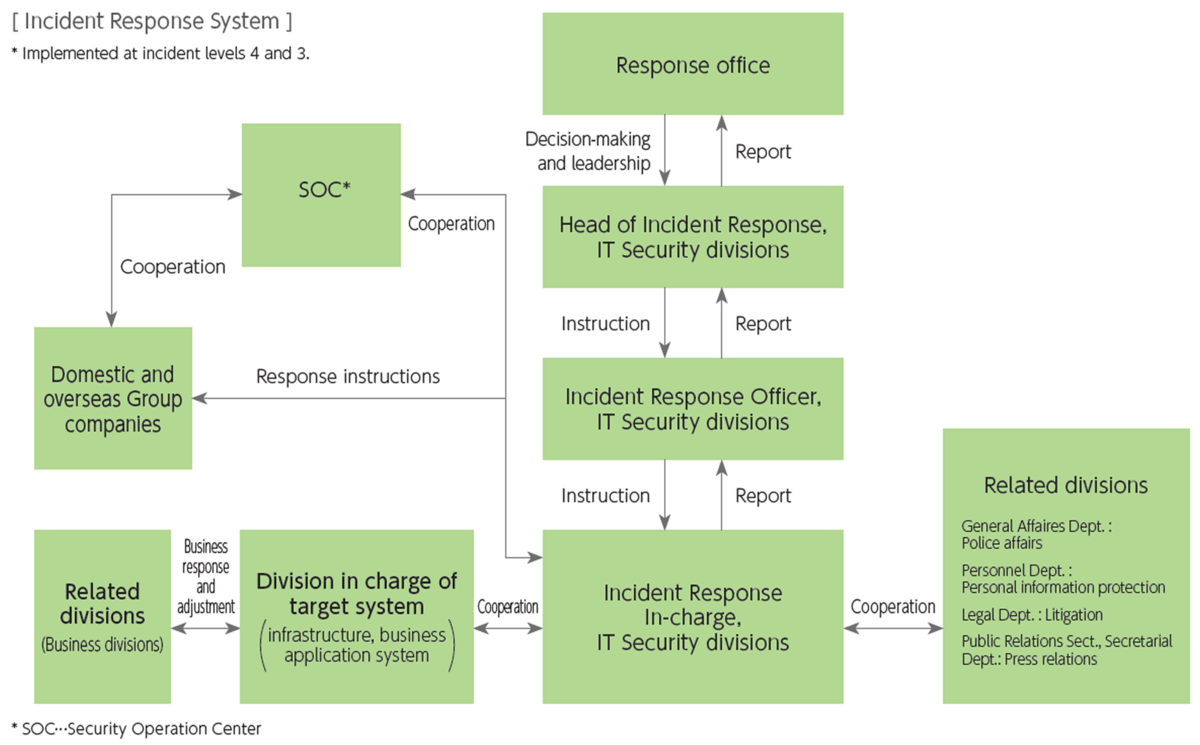
By establishing a Security Operations Center (SOC) system and conducting monitoring, we strive to detect signs of cyberattacks and other threats early, thereby preventing incidents and responding quickly. In the event of an incident, we have established a system to collaborate with relevant departments to identify the cause, confirm the scope of impact, implement recovery measures, and consider measures to prevent recurrence.
Education and Training
We conduct targeted email training three times a year and e-learning on information security once a year for our parent company and group companies. In addition, as part of HANWA Corporate University (HKBS) initiative, we hold a lecture series once a year by external lecturers on topics such as generative AI and cybersecurity. Furthermore, to ensure our ability to respond to cyberattacks and to promote understanding among internal stakeholders, Information System Dept. conducts cybersecurity training once a year.
Internal Dissemination and Education Activities
Our group provides education and training on risk management to all employees, and we strive to foster awareness of risk management by promptly sharing risk information.
The sales department has a clearly defined role in fostering and instilling a sound risk culture, and Risk Management Dept. is responsible for formulating and implementing matters related to risk management training and other related activities.
Going forward, we will continue to enhance risk management education, utilize e-learning, and strengthen practical training through the sharing of case studies, thereby improving the effectiveness of risk management throughout the group by fostering and permeating a risk culture.