
Dealing with Climate Change
Basic Concept
Climate change has had various impacts on not only the natural environment such as ecosystems but also people’s lives and corporate activities, and these impacts are expected to become more severe in the future. In light of these circumstances, we recognize responding to climate change as an important issue. With an eye on both the impact of business activities on climate change and the impact of climate change on the Company, we will promote the reduction of GHG emissions in business activities and initiatives to realize a carbon neutral society through businesses, and by minimizing the risks posed by climate change, we are committed to reducing GHG emissions in business activities.
Governance
As a trading company, the Group handles a diverse range of
products and recognizes the possibility that climate change
could have an impact on the Group in many ways. Accordingly,
based on the recommendations of the TCFD (Task Force on
Climate-related Financial Disclosures), we actively disclose
information on the impact of climate change on the Group and the
status of our response. We also position addressing climate
change as a key issue and aim to enhance corporate value
sustainably while coexisting with the environment and society.
As a governance structure, we have established the
Sustainability Promotion Committee, which is chaired by the
officer supervising the corporate divisions and consists of
members selected from the corporate divisions and the sales
divisions. The committee discusses and examines important issues
related to climate change, proposes and plans response measures
under the direction and supervision of the Board of Directors,
and decides on responses after discussion by the Board of
Directors.
Executive management verifies the results of
the assessment and the status of risk management for
climate-related risks and opportunities presented by the
Sustainability Promotion Committee to the Board of Directors or
Management Committee, and directs improvements or reviews of
business plans as necessary. The activities of the committee are
reported to the Board of Directors twice a year.
Strategy
Given the uncertainties arising from climate change, we regularly identify risks and opportunities through scenario analysis techniques. We consider the potential future impact of climate change on our business with reference to externally published scenarios, as well as the likelihood of a financial impact and the prioritization of responses to risks and opportunities. In FY2025 we set two temperature scenarios, the 4°C scenario and the 1.5°C scenario, and analyzed the impact on all of the Group’s businesses for time frames of 2030 and 2050.
Scenario assumptions
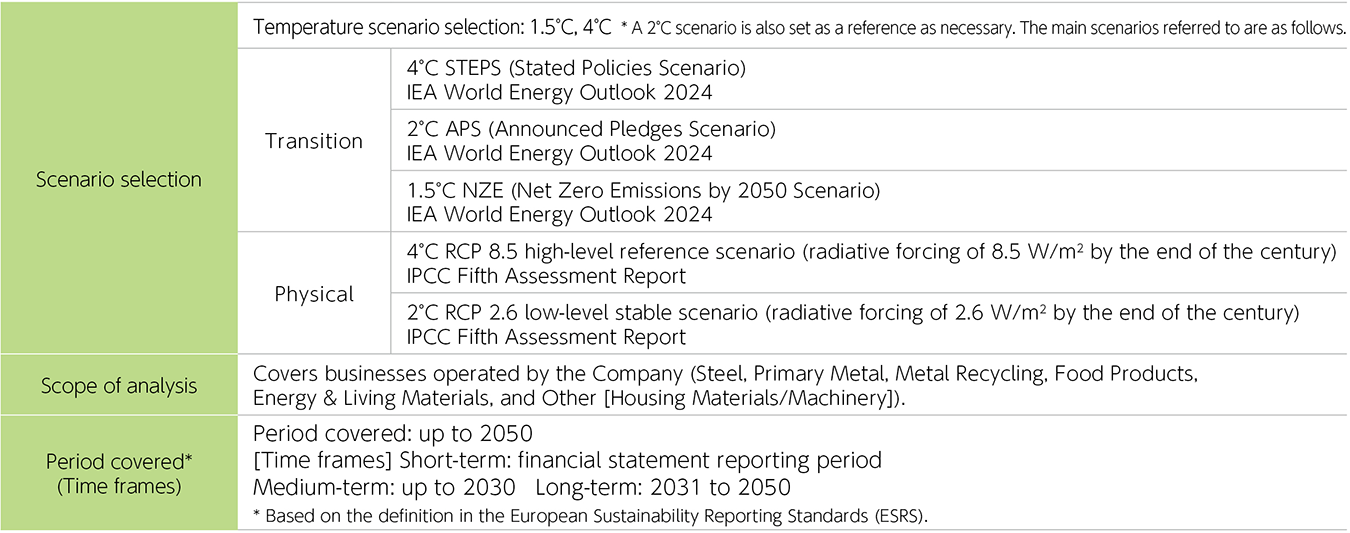
Major risks and opportunities related to climate change
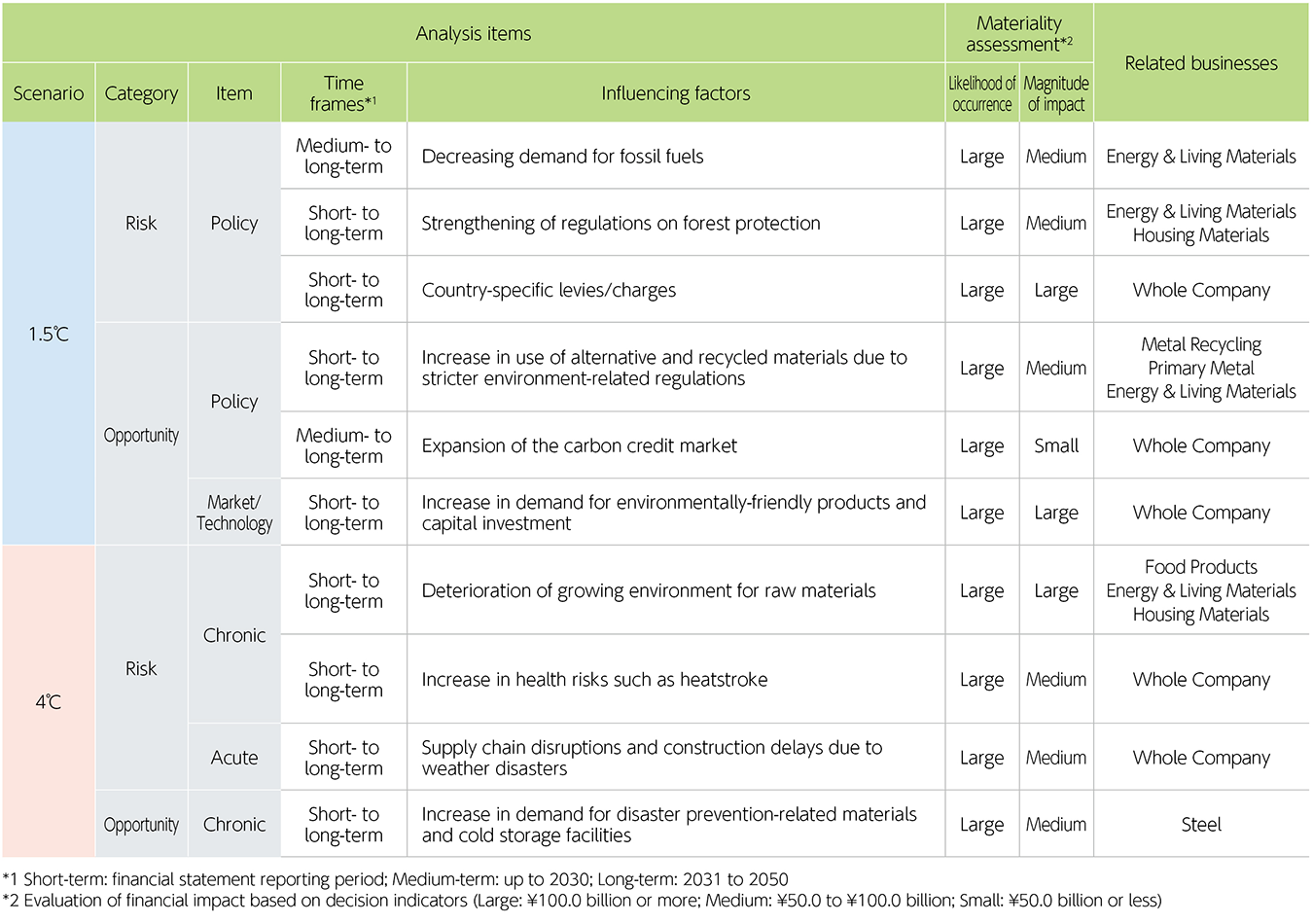
Summary of the financial impact on the business under each scenario
1.5℃ scenario
This scenario assumes that the public and private sectors will work together to promote climate change mitigation measures to achieve carbon neutrality, as the market for decarbonization-related products expands, regulations are strengthened, such as the introduction of carbon taxes, and structural changes occur in energy markets. In the Group, while demand for recycled products, biomass energy, and critical battery metals for electrification are expected to grow, there are concerns about the risk of shrinking sales of fossil fuel-derived products. In addition, the introduction of a carbon pricing system may may increase production costs based on environmental impact, and the growing need for environmentally-friendly products and sustainable raw materials will create new business opportunities.
4℃ scenario
This scenario assumes that efforts related to climate change mitigation will not be sufficiently advanced and that rising temperatures will result in physical risks such as flooding, storm surges, and more frequent extreme weather events. In such an environment, companies are required to build resilience against physical impacts caused by climate change. Due to the nature of the Group’s business, which has an extensive supply chain and inventory assets, there are concerns about supply chain disruptions and damage to inventory and buildings caused by weather-related disasters. On the other hand, due to the growing awareness of disaster prevention, the steel and other products we handle for reinforcing social infrastructure are expected to contribute to stakeholders and local communities from the perspective of adaptation to climate change.
Policy for addressing risks and opportunities
Through scenario analysis, the Group recognizes that climate change is an important issue that must be addressed in terms of both risks and opportunities, and we intend to take appropriate measures to address the issue. In particular, we recognize that metals and energy-related products are significantly affected by changes in demand due to climate change, and we believe it is necessary to consider business strategies based on the future market environment. The status of considerations regarding risks and opportunities identified as of today is as follows.
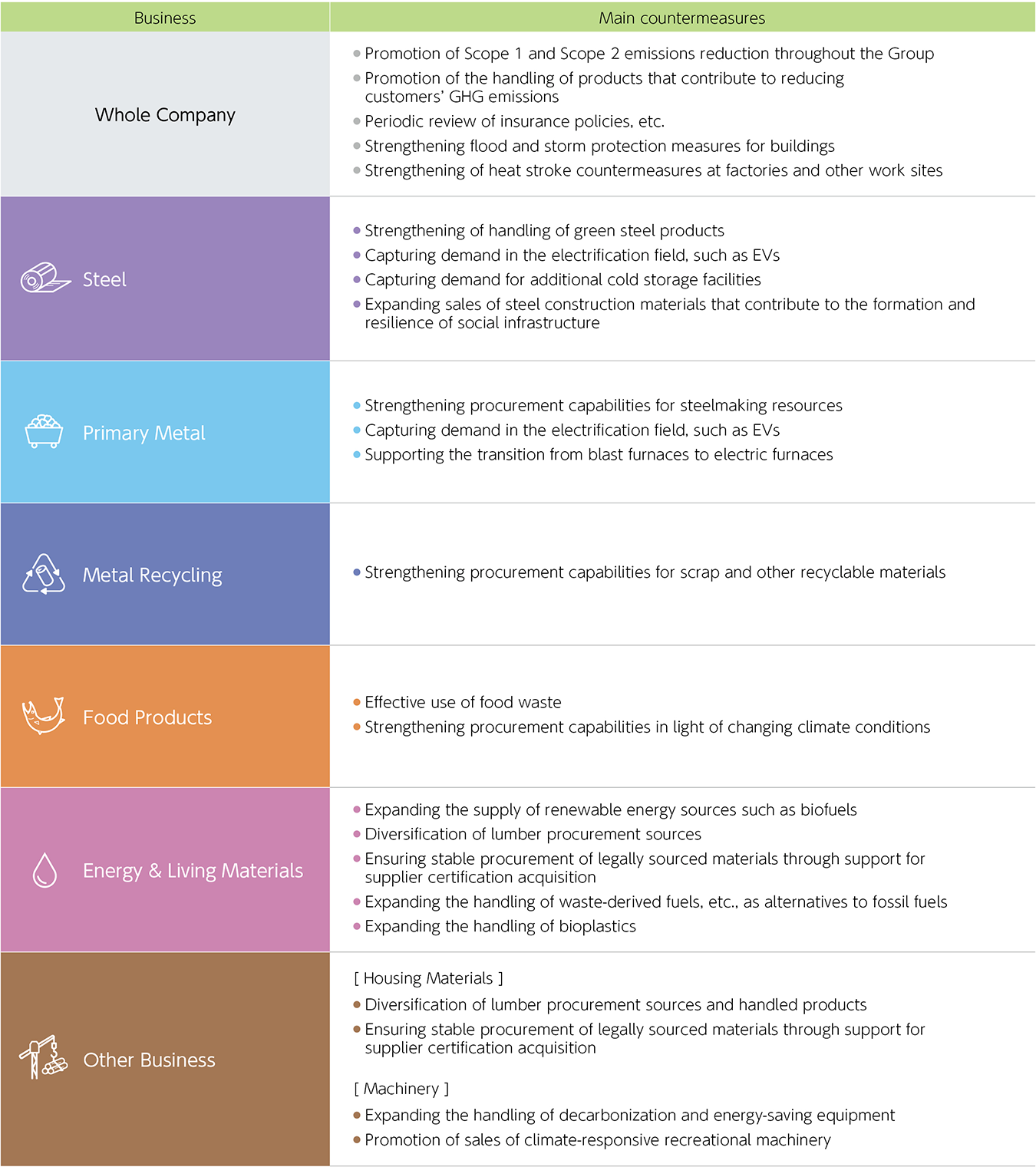
Risk Management
The Group has a system in place to manage risks related to
climate change under the direction and supervision of the Board
of Directors, with the Sustainability Promotion Committee taking
the lead in gathering information, identifying and assessing
risks and opportunities, and reporting the results to the Board
of Directors. The management manages climate change risks by
formulating a management plan and determining investments based
on the identified and assessed risks, and incorporating risk
mitigation measures into daily operations as necessary.
The identification of risks and opportunities related to
climate change utilizes scenario analysis techniques. In
assessing significance, we conduct evaluations in three stages
based on two axes: the scale of financial impact and the
likelihood of occurrence, in addition to estimating the timing
of occurrence. Risks and opportunities identified and evaluated
are prioritized in consideration of their relevance to other
sustainability issues, and specific measures are gradually
considered and implemented.
Among various risks, we
position those that may have a significant impact on our
management as key risks, and recognize climate change as one of
the risks with a major impact on management. To manage these key
risks professionally, we have established the Risk Management
Department. We are building an integrated risk management
framework on a consolidated basis through the formulation of
necessary policies and development of rules, ensuring that we
can effectively manage risks in cooperation with the relevant
departments.
Indicators and Targets
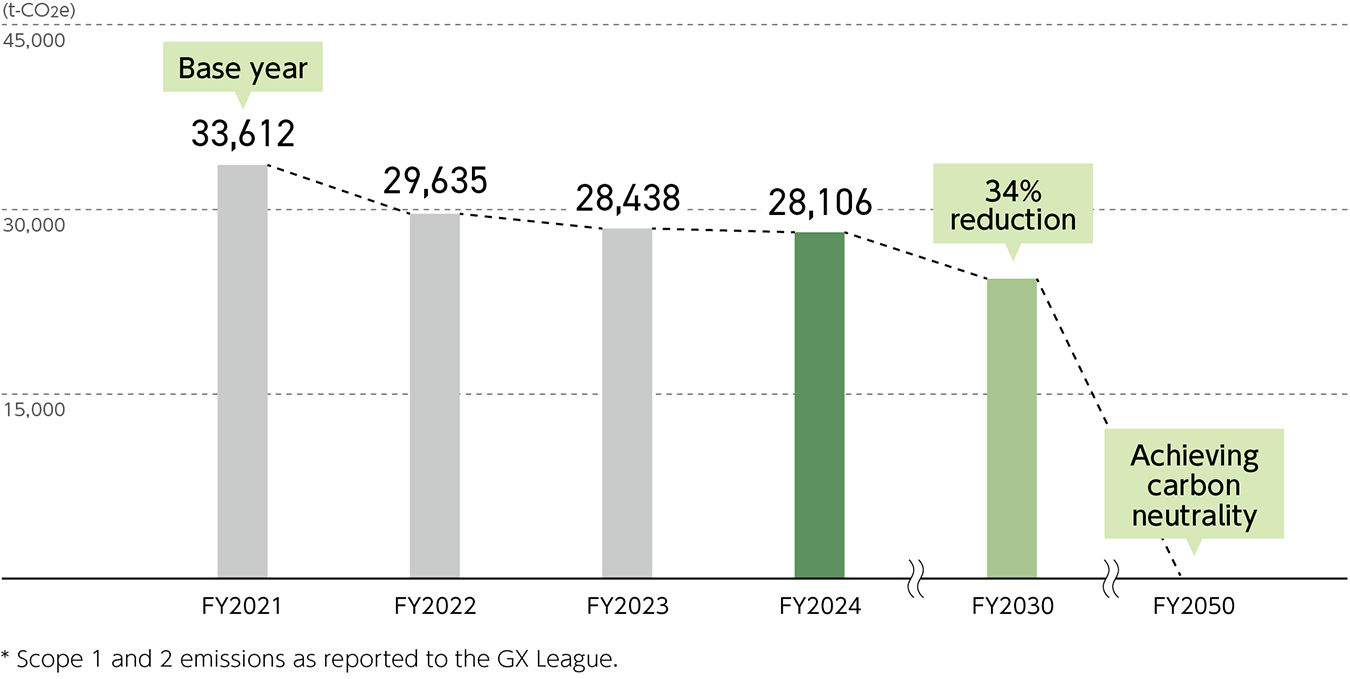
GHG emission reduction targets
To achieve carbon neutrality, which is one of the materialities of the Group, we have established medium- to long-term reduction targets using GHG emissions as an indicator. The targets are as follows.
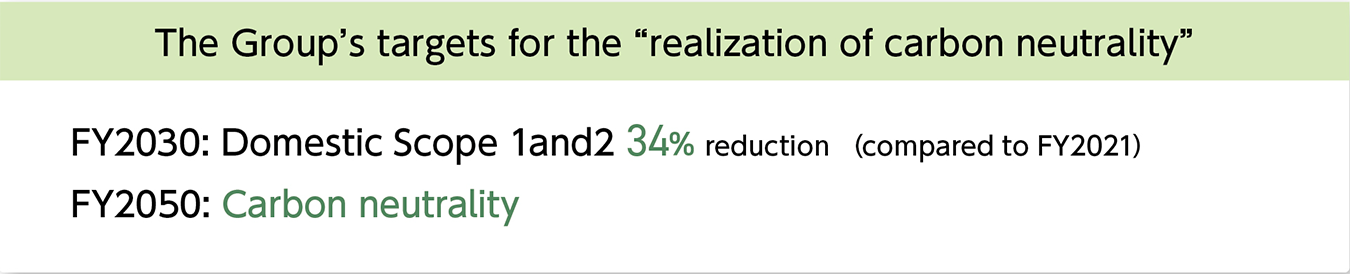
The Group's domestic GHG emissions (Hanwa Co., Ltd. + consolidated subsidiaries in Japan)
Please see below for climate related data in our ESG disclosures.
Internal Carbon Pricing (ICP) (for internal reference)
In order to strengthen our response to climate change risks, we have introduced a mechanism to apply an internal carbon price. This involves assigning a price to GHG emissions related to the commodities we handle and using it as a reference for transactions. The price refers to $140/t-CO2 in 2030, based on the IEA World Energy Outlook. This is a trial initiative to enhance our ability to respond to future risks, and there are no plans for external disclosure.
Climate Change Initiative
Support for TCFD recommendations
We have expressed our support for the TCFD recommendations.
* TCFD refers to the Task Force on Climate-related Financial Disclosures established by the Financial Stability Board (FSB) at the request of the G20 in order to study how to disclose climate-related information and deal with financial institutions.

Endorsement of the GX League Basic Concept
We support the "GX League Basic Concept" announced by the Ministry of Economy, Trade and Industry.
* The GX League was established as a place where "corporations" that actively work on GX (Green Transformation) collaborate with the government and academia.

Response to the CDP Questionnaire
Since 2024, we have been providing responses to the CDP questionnaire. We obtained a B score for Climate Change in CDP 2025.
* CDP is an international non-profit organization established in 2000 that requests information disclosure and conducts analysis and evaluation of the initiatives taken by companies and local governments in the areas of climate change, water security, and forests.
Response to and Support for Public Regulations
At each of our domestic and overseas bases, we support laws and regulations regarding climate change countermeasures and reduction of energy usage (such as the 'Act on Promotion of Global Warming Countermeasures' and the 'Act on the Rational Use of Energy' in Japan) as well as policies, and are responding to them appropriately.